Wallet-derived key
A wallet signature derives the encryption key, with no separate chat password.
Work 04 / TapeSend
TapeSend is DeWEB's real-time encrypted messaging layer: every TapeOut circuit container can become an address, content is encrypted end to end, and clients read and verify several chains directly without a bridge, centralized indexer, or message server.
How it differs from TapeKit: TapeKit reads websites from chains; TapeSend lets circuit containers on different chains exchange messages. They share multi-chain reads and container identity, but solve separate problems.
01 / Positioning
Founder Blonskr announced TapeSend on 2026-09-19 as a real-time encrypted channel spanning multiple chains — DeWEB infrastructure for communication, alongside its website layer. The participants are not conventional usernames: they are TapeOut circuit containers. Holding a container controls the right to send and receive as that identity.
02 / Message path
A wallet signature derives the encryption key, with no separate chat password.
The sender's device encrypts the content; only ciphertext and verification data go on-chain.
The message enters the DeWEB Hub on the sender's chain, rather than being bridged elsewhere.
The recipient client reads multiple chains and checks the payload against its on-chain digest.
15324.30. X Layer uses area code 2, such as 1.2.0. The founder demonstrated two-way messaging between those containers.03 / Core capabilities
Content is encrypted locally and stored on-chain as ciphertext; no centralized service receives the content key.
The key derives from a wallet signature. Transferring the container transfers the receiving identity, while key rotation can reset access.
Messages remain on the sender's chain; the client aggregates data from multiple chains, avoiding bridge custody and bridge exploits.
Clients read inboxes, outboxes, and events directly, keeping a centralized database out of the message path.
Once written, the recipient can discover the message within seconds; actual speed depends on chain confirmation and node response.
Small attachments can be encrypted in the payload; asset attachments are verified as transfers into the recipient's container.
04 / Clients and source
TapeSend lives inside the open-source TapeKit repository under the MIT license. The repository includes messaging contracts, the @tapekit/send protocol module, and a client intended as a commercially usable starting point.
| Component | Purpose |
|---|---|
send/contracts | DeWEB Hub, proxy, and deployment tests for on-chain inboxes, outboxes, and message events. |
send/module | Key derivation, encryption, endpoint addresses, strict multi-node reads, and attachment verification. |
apps/tapesend | Web, Mac/desktop (Electron), iOS, and Android (Capacitor) clients. |
04A / Third-party applications
Within 24 hours of TapeSend's release, the community had shown three distinct instant-messaging shells. They share circuit-container identity and the TapeSend message layer, but the public evidence for each is at a different stage. The notes below include only capabilities directly supported by the developers' posts and screenshots.
Community developer Hong Qigong (@CryptoLoser9) introduced TAPQQ on 2026-09-19 and completed its public release on September 20, inviting users to try sending messages. Its early-QQ visual language wraps circuit-container identity, wallet signatures, and the DeWEB message channel in a familiar consumer IM experience.
The new screenshots show TAPQQ reading the BSC mainnet inbox and outbox, aggregating recent on-chain contacts, and displaying conversations. The interface also exposes strict multi-node status: when Base nodes are temporarily unavailable, messages from that chain remain visible while attachment verification pauses and retries automatically.
1-888.tapekit.org now loads the TAPQQ login screen and exposes wallet connection. The developer narrowed the first release to person-to-person messaging, leaving attachments and asset features for later updates, and explicitly warns that the early build may still contain many bugs.
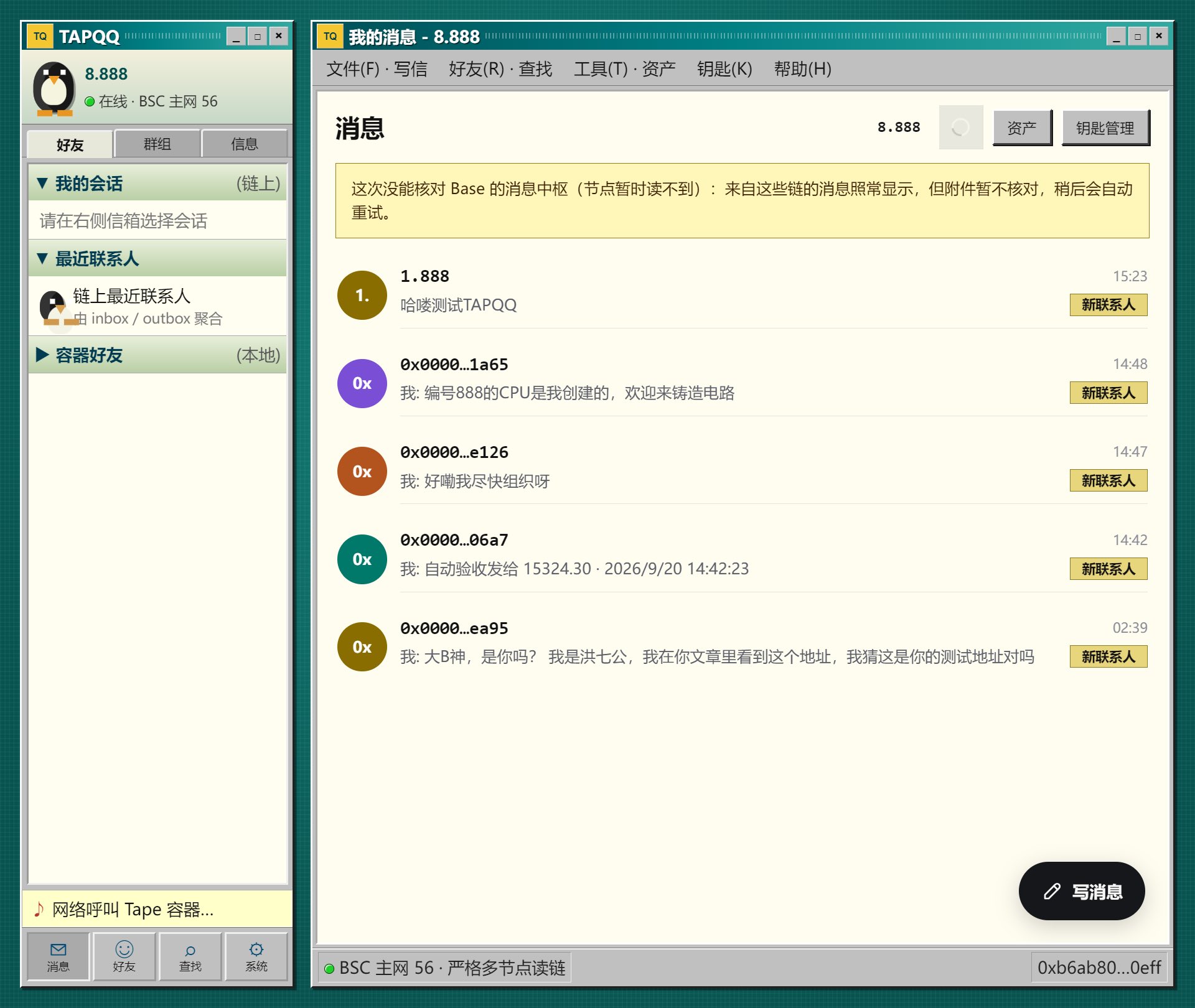
8.888, recent on-chain contacts, and inbox / outbox aggregation.The DeQQ screenshot from @0xkEvinC explicitly labels the product as “TapeSend multi-chain messaging” with end-to-end encryption. It exposes wallet connection, friend search/add, inbox, sent items, and identity entry points, while listing BNB, X Layer, and Base. The post itself only says the author “made a tape version of QQ for fun,” so these are demonstrated UI surfaces, not proof that every function has passed mainnet testing.
@Xiao_zhanyang showed TapeChat running in the Binance app's built-in browser: users can select a container identity, view conversations, compose messages, and inspect messages with BNB Smart Chain block numbers and quoted replies. It demonstrates that a TapeSend client can enter an exchange app's DApp-browser environment; the developer also says optimization is ongoing.
Verification note: the roundup article says TAPQQ attachment transfer was already working, but TAPQQ's developer later stated that version 1.0 focuses on message exchange and that attachments and assets will come later. This page follows the primary developer update and does not list attachments as a shipped 1.0 capability.
View the initial TAPQQ update → · View the TAPQQ release note → · Open the TAPQQ on-chain address → · View the three-client roundup →
05 / Security boundaries
Message content is encrypted, but observers can still see who messaged whom, when, and approximately how much data was sent.
A message is a transaction on the sender's chain. Gas-free access applies to reading DeWEB sites, not to writing an on-chain message.
06 / Milestones
The founder fully open-sourced TapeSend, announced the processor factory, circuit containers, site repository, and message hub on X Layer, and demonstrated two-way end-to-end encrypted messaging between X Layer container 1.2.0 and BNB Chain container 15324.30.